

Guides · Buying
Assumable mortgages: when taking over the seller's rate actually works
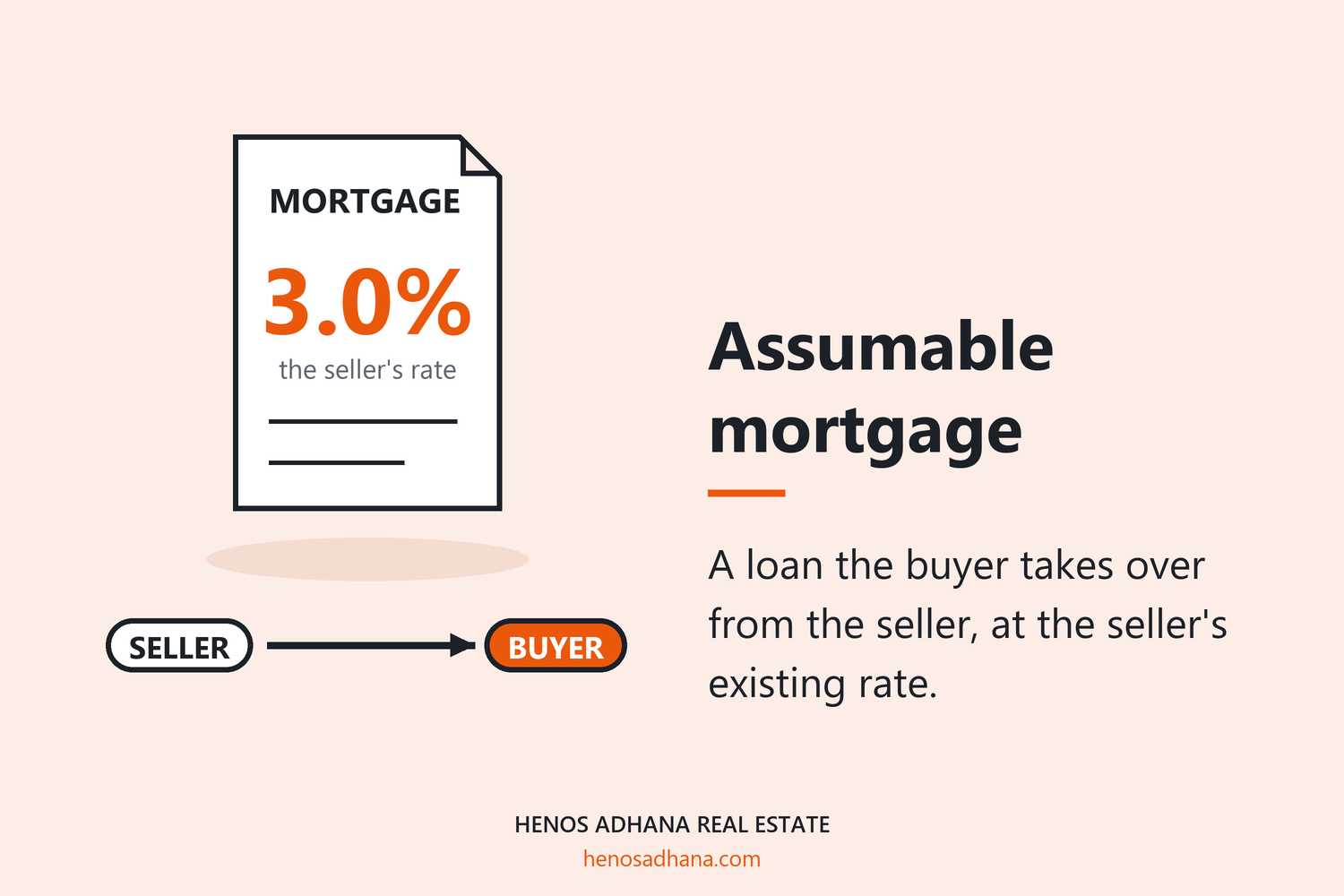
FHA, VA and USDA loans can usually be assumed, which means the buyer takes over the seller's existing loan at the seller's existing rate. Conventional loans generally cannot. The thing that decides whether an assumption is possible is not the rate, it is the gap: the buyer has to cover the difference between the loan balance and the purchase price in cash or a second loan. On a house that has doubled since 2019, that gap is usually the whole conversation.
What an assumable mortgage is#
What is actually assumable#
FHA, VA and USDA loans are assumable, subject to the lender approving the buyer. The buyer still has to qualify; an assumption is not a way around underwriting, it is a way around today's rate.
Conventional loans generally are not. Almost all of them carry a due-on-sale clause, which lets the lender call the balance when the property changes hands. There are narrow federal exceptions, mostly for transfers between family members, on death, or into a living trust, and they are not a route for an ordinary sale.
So the first question on any listing is not "is it assumable" in the abstract. It is which loan the seller actually has, and the answer is on their mortgage statement.
Wondering what this means for your budget?
Book a 30-minute buying callThe gap is the whole problem#
This is the part the headlines skip, and it is the reason most assumptions never happen.
When you assume a loan you take over the balance, not the price. Everything above the balance is yours to fund. If the seller bought in 2019, owes $340,000, and the house is now worth $850,000, assuming that loan means finding $510,000.
That is not a down payment. It is a gap. You can fill it with cash, or with a second loan, and a second loan at today's rate on half the purchase price quietly undoes much of what the 3% first was worth. Run the blended rate before you fall in love with the idea.
Where assumptions genuinely shine is the opposite shape: a seller who bought recently with little money down, has not built much equity, and holds a low rate. Smaller gap, same cheap money.
If it is a VA loan, the seller has more at stake than the buyer#
A VA loan can be assumed by anyone the lender approves, veteran or not. What changes with the buyer's status is what happens to the seller.
When a non-veteran assumes a VA loan, the seller's entitlement stays tied to that loan until it is paid in full. It is not restored at closing. A veteran who sells this way can find their benefit locked into a house they no longer own, for as long as the buyer takes to pay it off, which may be decades.
There is a clean way out: a veteran buyer can substitute their own entitlement, which releases the seller's. That makes a veteran buyer meaningfully more valuable to a veteran seller than a non-veteran one, and it is worth saying out loud in the negotiation.
Two more VA specifics. The assumption carries a funding fee of one half of one percent of the loan balance at transfer. And the assumption must be processed as an approved transfer with a release of liability — without it the seller stays on the hook for a loan on somebody else's house.
Never let a VA seller agree to an assumption without confirming the release of liability and what happens to entitlement. Those two sentences are the difference between a clever sale and a problem that follows them for years.
Sources
- Circular 26-23-10, loan assumptions, U.S. Department of Veterans Affairs
- VA Home Loan Guaranty Buyer's Guide, U.S. Department of Veterans Affairs
Time is the other cost#
An assumption is processed by the seller's loan servicer, not by a lender competing for your business. Nobody at the servicer is in a hurry, and there is no commission riding on it.
Plan for an assumption to take considerably longer than an ordinary financed purchase, and write the contract to match. A thirty-day closing date on an assumption is a promise you cannot keep.
Practical steps that save weeks: get the seller to request the assumption package from their servicer before the house is listed, confirm in writing that the loan is assumable and what the servicer's processing time is, and find out whether the servicer requires its own appraisal.
If the seller cannot tell you who services the loan and whether it is assumable, treat the listing's "assumable" claim as marketing until proven otherwise.
What it is worth, in numbers you can check#
Work it out before you chase it. Take the balance you would assume and its rate, take the gap and what a second loan on the gap would cost today, and compare the combined monthly payment against a plain purchase at today's rate with the same money down.
Sometimes the answer is dramatic, and on a small gap it can be worth hundreds of thousands over the life of the loan. Sometimes the second loan eats it, and you have taken on a slower, more fragile transaction for very little.
Do the same arithmetic on the exit. An assumable low rate is an asset you can hand to the next buyer, which is worth something when you sell, and worth more if rates are still high then.
What you will need at closing either way does not change much, and the difference between a pre-approval and a full underwrite matters more than usual here, because servicers move slowly and a strong file is the only thing that speeds them up.
If you are selling with a low rate#
Your rate is a feature of the house. Advertised properly, it widens the pool of buyers who can afford your price, because the monthly payment at 3% on part of the balance is not the payment anyone else can offer.
Before you advertise it, confirm three things with your servicer: that the loan is in fact assumable, what they charge to process it, and how long they take. An assumption advertised and then refused is worse than never mentioning it.
And if it is a VA loan, settle the entitlement question first. It is the one detail that can cost you far more than the sale is worth.
Common questions#
Which mortgages are assumable?
FHA, VA and USDA loans generally are, with the lender's approval and the buyer qualifying. Conventional loans generally are not, because of the due-on-sale clause, apart from narrow federal exceptions such as transfers on death, between family members, or into a living trust.
Can you assume a mortgage without qualifying?
No. The servicer underwrites the buyer much as a new lender would. What an assumption gets you is the seller's interest rate, not a way around credit, income or the paperwork.
What is the gap in an assumable mortgage?
The difference between the loan balance you take over and the price you agreed. The buyer covers it in cash or with a second loan. On a house that has gained a lot of equity it is often several hundred thousand dollars, which is usually what kills the idea.
Does assuming a VA loan use my VA entitlement?
Only if you are a veteran and choose to substitute your entitlement, which releases the seller's. If a non-veteran assumes, the seller's entitlement stays tied to the loan until it is paid in full and is not restored at closing.
What does a VA assumption cost?
The transferee pays a funding fee of one half of one percent of the loan balance as of the date of transfer, plus whatever the servicer charges to process the assumption.
What is a release of liability?
The lender formally releasing the original borrower from responsibility for the loan. Without it, a seller whose buyer stops paying is still on the hook for a mortgage on a house they no longer own. It is the single most important piece of an assumption for a seller.
How long does an assumption take?
Longer than a normal purchase, and the time is in the servicer's hands rather than a lender competing for your business. Ask for the servicer's processing time in writing before agreeing a closing date.
Is an assumable loan worth chasing?
It depends entirely on the gap. Compare the blended cost of the assumed loan plus whatever funds the gap against a straightforward purchase at today's rate. On a small gap it can be worth a great deal; on a large one the second loan often eats the benefit.