

Guides · Buying
Buying a condo in Seattle: read the building before you buy the unit
With a condo you are buying into the association's finances as much as the unit. In Washington the association has 10 days to produce a resale certificate once the seller asks, and you can cancel within five days of first receiving it. Use that window to read the reserve study, any special assessments, the insurance and the rental rules, and check early whether your loan type works in that building. Dues, and what they have done over the last three years, are the other half of the price.
The resale certificate#
What you actually own#
A condo is a form of ownership, not a type of building. You own your unit, usually from the walls in, and a share of everything else: the roof, the structure, the lobby, the elevators, the land. The association runs all of that, and your dues pay for it.
That is why the paperwork matters more than the finishes. A beautiful unit in a building with thin reserves and a tired exterior is a special assessment waiting to happen.
Wondering what this means for your budget?
Book a 30-minute buying callIs a condo worth it in Seattle?#
It depends on two things: how long you plan to hold it, and how well the building is run. The unit is the easy part. Almost everything that decides whether the purchase works out sits in the association's paperwork.
What you get
- A way into neighbourhoods where a house is out of reach, usually at a lower price per square foot.
- Someone else's problem when the roof leaks, the lift stops or the siding needs work.
- No yard, no gutters, no exterior to maintain.
- Security, parking, and in many buildings water and sewer, bundled into one monthly figure.
What you give up
- Dues you do not control, set by a board and revised every year.
- The risk of a special assessment for work the reserves cannot cover.
- Rules on rentals, pets, parking and renovations, enforceable against you.
- A narrower buyer pool when you sell, because the building has to satisfy your buyer's lender too.
Hold time is the thing most buyers underweight. If you are buying for three years, the cost of selling and the risk of an assessment are the numbers to look at. If you are buying for ten, how well the reserves are funded matters more than what you pay this month.
Houses and condos are separate markets right now#
In Seattle this year the two have behaved differently. Houses priced to the market still sell. Condos have been slower, with more of them for sale and more room to negotiate, according to the brokerage reports that track Northwest MLS data.
Condos are a small slice of what sells here. In August 2026, 680 of the 5,861 closed sales across the Northwest MLS service area were condominiums. A thin market cuts both ways: fewer buyers competing with you now, fewer comparable sales when you come to sell.
That is good news for a condo buyer, with one caution. A building where many owners want out can struggle to fund its repairs. A soft market makes the documents more important, not less.
Current medians by neighbourhood sit on the market report.
Sources
- Market Snapshot, August 2026, Northwest Multiple Listing Service
What a condo costs to own, month to month#
The purchase price is the smaller half of the decision. A condo carries a monthly figure the seller cannot negotiate away, and it is the one buyers underestimate.
Dues usually pay for the master insurance policy, water and sewer, common-area power and cleaning, management, landscaping, and the contribution to reserves. They do not pay for your own insurance, your property tax, or parking and storage where those are billed separately.
Compare dues per square foot, not per month. A larger unit in a plain, well-run building often costs less per foot than a small one in a building with a concierge and a pool. The listing carries the dues figure. Ask what it includes, because two buildings quoting the same number can be charging for very different things.
Then ask what the dues have done over the last three years, and what share of them goes to reserves. A building that has held dues flat while costs rose is usually not saving; it is postponing. Insurance and utilities are the lines most likely to push them up again.
Property tax works the same way it does on a house: King County assesses your unit, and you pay it through your lender or directly.
Built as a condo, or converted from apartments#
Two buildings on the same street can look alike and behave nothing alike. One was designed and built to be sold as individual units. The other was an apartment building whose owner recorded a condominium declaration and sold the units off.
The difference shows up in what you cannot see on a tour: how sound travels between units, whether plumbing and electrical were built to be separated and metered, how parking was assigned, and what was left behind in reserves.
You can tell them apart from the documents. Compare the year the building was built with the date the condominium declaration was recorded. A gap of years means a conversion.
Neither is automatically better. A well-converted brick building can outlast a rushed new one. But a conversion deserves harder questions about what was actually replaced at the time, and a new building deserves questions about what the developer's warranty covered and whether anything was ever claimed under it.
New construction adds one more question: whether the building is finished and sold out. Until it is, the developer may still control the board, and the reserve study is a projection rather than a record.
The resale certificate, and your five days#
Once a resale condo is under contract, the seller asks the association for a resale certificate. The association has 10 days after the request to provide it, and can charge the seller up to $275 for it.
The certificate is the building's financial disclosure. It shows the current assessments and anything unpaid, any special assessments, planned major spending, where the reserve study stands, the latest financial statements and budget, unsatisfied judgments and lawsuits, the insurance, notices of code violations in the unit, rental restrictions and any right of first refusal.
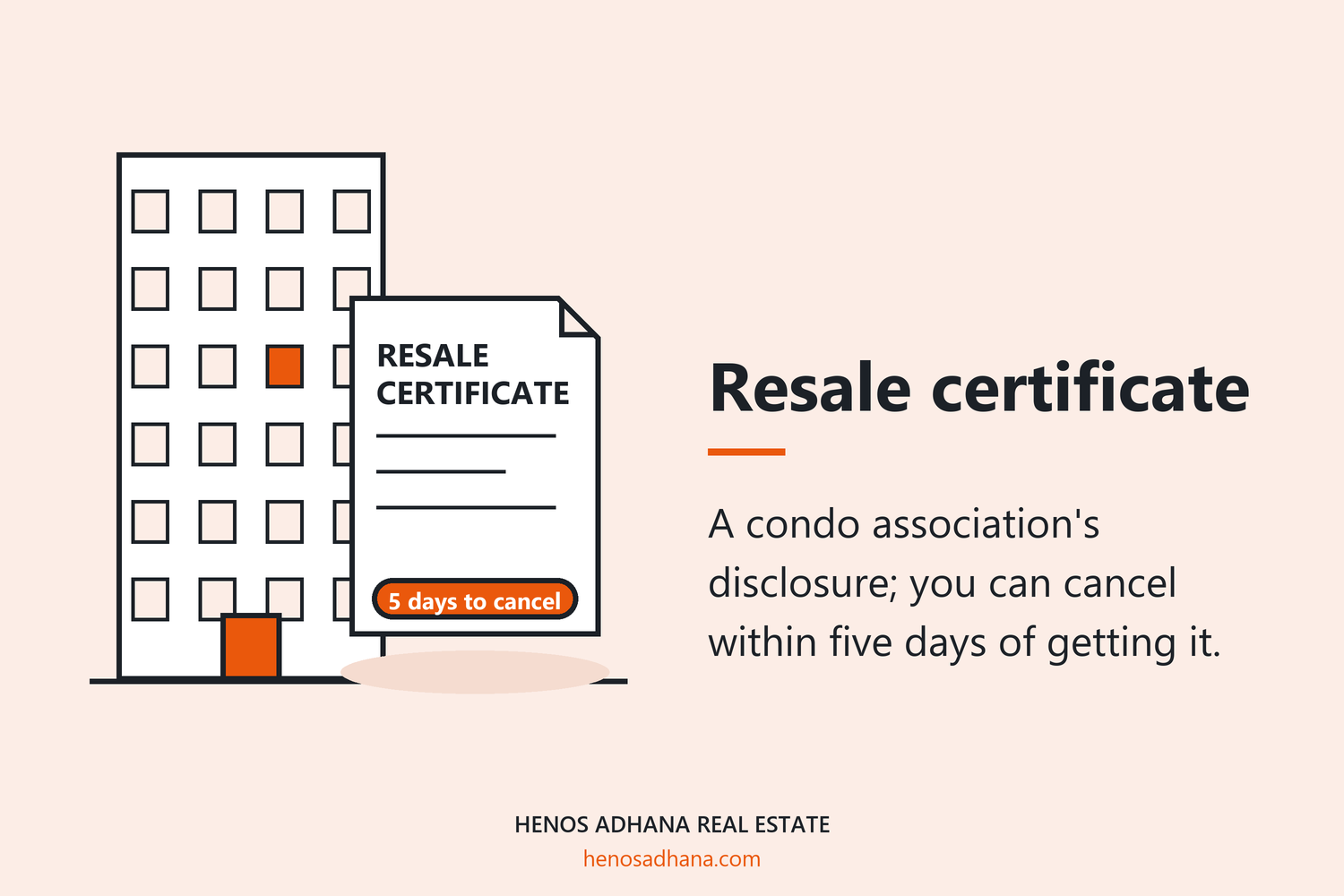
You can cancel the purchase within five days of first receiving it. Under the newer condo law, WUCIOA, it is five business days, and if the certificate arrives late you can push closing back to keep them. Many older Seattle buildings still sit under the older Condominium Act until 2028, where it is five days or until closing, whichever comes first. Either way, block the time in your calendar the day the certificate arrives.
Sources
- RCW 64.90.640, resale certificates under WUCIOA, Washington State Legislature
- RCW 64.34.425, resale certificates under the Condominium Act, Washington State Legislature
The reserve study#
Reserves are the association's savings for the big, predictable jobs: roofs, siding, windows, elevators, boilers, paving. Washington requires most associations to update a reserve study every year, and to have a reserve study professional do a visual site inspection at least every third year.
Read three things in it: how well funded the reserves are against what the study says they should be, the projects planned for the next five years, and what the study recommends the association put aside each year compared with what the budget actually puts aside. A gap between those last two is how special assessments happen.
Sources
- RCW 64.90.545, reserve studies, Washington State Legislature
Special assessments, and who pays them#
A special assessment is a one-time charge on every owner for work the reserves cannot cover. The resale certificate has to show any that are already approved.
If one has been approved but not yet paid, who pays it is a term you can negotiate. Raise it in the offer if you already know, rather than after the certificate arrives.
The meeting minutes are where assessments show up first, often months before a vote. Ask for the last year or two of them along with everything else.
Your loan and the building#
With a condo the lender underwrites the building as well as you. The budget, the reserves, how many units are owner-occupied, owners behind on dues, litigation, commercial space and how many units one owner holds can all come into it. A building that falls outside the mortgage agencies' standards is usually called non-warrantable. You can still finance it, but usually with more down and at a higher rate.
For an FHA loan, check HUD's list of approved condominium projects. If the building is not on it, FHA can still approve a single unit in some cases, on a longer list of documents. How to check a building against HUD's list is its own guide.
Ask your lender to look at the building before you write the offer, not after. It is the cheapest way to avoid a contract you cannot close.
Sources
- FHA-approved condominium search, U.S. Department of Housing and Urban Development
- FHA single-unit approval, required documentation, U.S. Department of Housing and Urban Development
Insurance, rentals and the rest of the rules#
The association's master policy covers the building. You buy your own policy for the inside of your unit and your belongings. Ask what the master policy's deductible is and how the declaration assigns it, because after a leak that deductible can land on the owner whose unit it started in.
Many associations cap or ban rentals, and the resale certificate has to show any restrictions. If you might rent the unit out one day, that is a question for before you offer, not after you move in. Pets, parking, storage and electric car charging all sit in the same documents.
The law changes on 1 January 2028#
Washington has governed condos and homeowners' associations under several different statutes, depending on when a community was created. From 1 January 2028 the older acts are repealed and one law, the Washington Uniform Common Interest Ownership Act, covers every community.
Many older buildings are amending their documents to get ready. The minutes will tell you whether yours has started, and whether the process has turned up anything expensive.
Sources
- Senate Bill Report, SB 5796 (2024), Washington State Legislature
- The impacts of standardizing the law applicable to community associations, Washington State Bar News
Common questions#
Is it worth buying a condo in Seattle?
It depends on how long you will hold it and how well the building is run. Conditions have favoured condo buyers more than house buyers lately, which leaves room to negotiate. A soft market does not fix a badly funded association, though, so the reserves matter more than the discount.
Are condo prices dropping in Seattle?
Condos have been the slower half of the Seattle market, with more of them for sale and more room to negotiate than on the house side. What matters for the unit in front of you is narrower than any citywide number: check what has sold in that building in the last year, and what is listed there now.
How much does it cost to buy a condo in Seattle?
Three numbers, not one: the price, the monthly dues, and closing costs. Dues are the one buyers underestimate, because a board sets them and revises them every year. Ask what they cover, what they have done over three years, and how much of them goes to reserves.
What do condo HOA dues cover?
Usually the master insurance policy, water and sewer, common-area power and cleaning, management, landscaping and the contribution to reserves. Not your own insurance, your property tax, or parking and storage where those are billed separately. Compare dues per square foot between buildings rather than per month.
Why are condos not selling right now?
Financing is the usual reason. A building that falls outside the mortgage agencies' standards, or whose FHA approval has lapsed, loses a large share of its buyers overnight. Rising dues and insurance costs do the rest. Buildings that are well funded and easy to lend on still sell.
Is it financially smart to buy a condo?
It can be, if the building is well run and you hold it long enough to clear the cost of buying and selling. The risk specific to condos is the one you do not control: a board can raise dues or approve a special assessment, and you pay your share either way.
What is a condo resale certificate in Washington?
The association's disclosure for a resale unit: assessments, special assessments, the reserve study's status, financial statements, lawsuits, insurance, rental restrictions and more. The association has 10 days to provide it and can charge up to $275.
How long do I have to cancel after I get the resale certificate?
Five days from first receiving it. Under WUCIOA it is five business days. Under the older Condominium Act, which covers many older buildings until 2028, it is five days or until closing, whichever comes first.
What is a reserve study?
A plan for the association's big, predictable repairs and how much it should save for them. Washington requires most associations to update it every year, with a professional site inspection at least every third year.
Can I use an FHA loan on a Seattle condo?
If the building is on HUD's list of approved projects, yes. If it is not, FHA can sometimes approve a single unit instead. Ask your lender to check the building before you make an offer.
What is a non-warrantable condo?
One in a building that falls outside the mortgage agencies' standards, for reasons such as litigation, thin reserves, a lot of commercial space or one owner holding many units. It can still be financed, usually with a bigger down payment and a higher rate.
Who pays a special assessment when a condo sells?
Any assessment already approved has to appear on the resale certificate. Who pays one that is approved but unpaid is negotiable, so settle it in the purchase agreement.