

Guides · Buying
Dual agency in Washington: should the listing agent represent you too?
It can, if you and the seller both agree in writing, but the broker then works for both of you and can negotiate for neither. A limited dual agent still owes you honesty, reasonable care and disclosure of known material facts, but cannot advocate for you against the seller or pass on either side's confidential information, such as the most you would pay. Your alternatives are a different broker at the same firm, or a broker of your own.
What limited dual agency is#
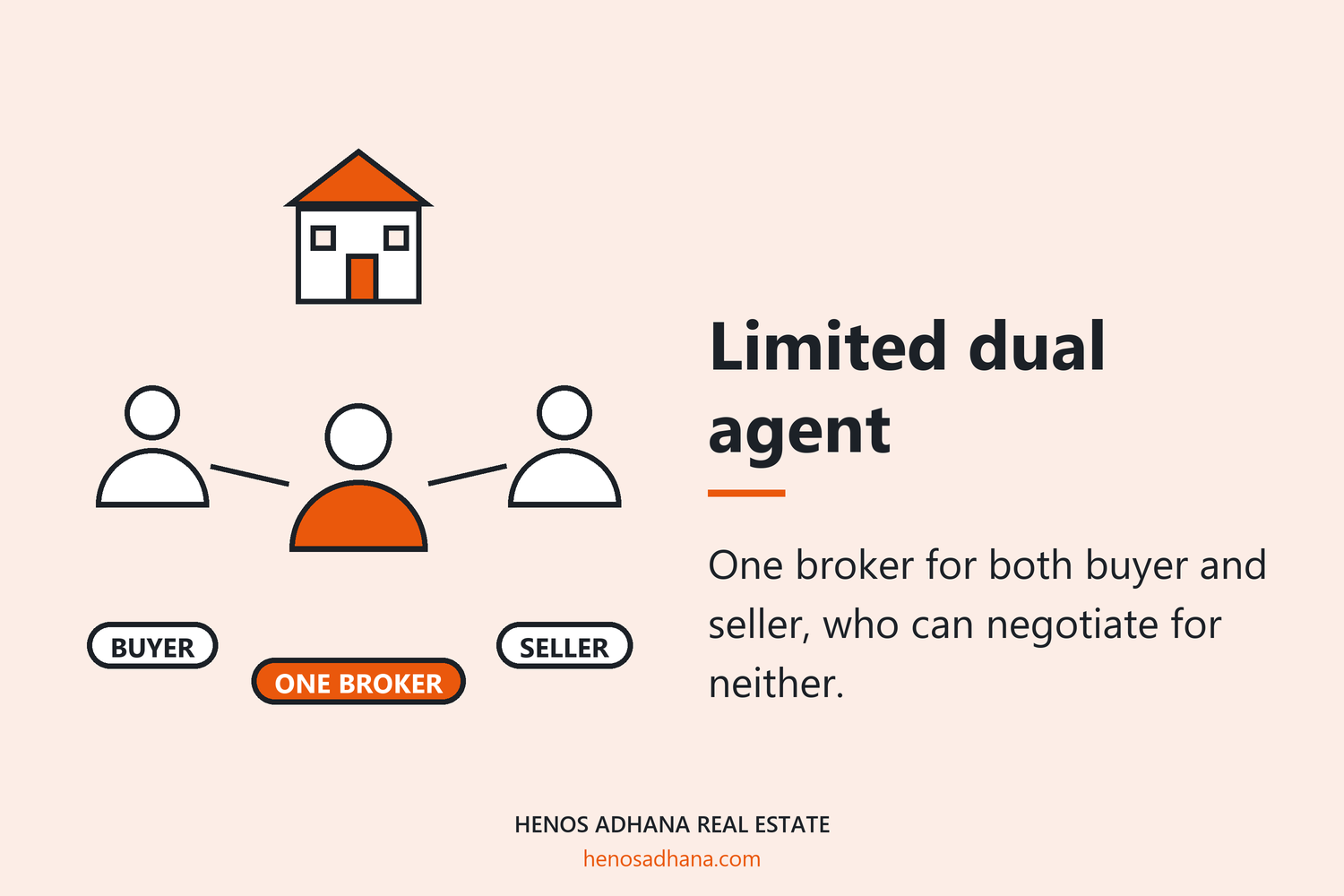
What limited dual agency means in Washington#
Washington calls it limited dual agency. A limited dual agent is a broker who represents both the buyer and the seller in the same transaction, and the law allows it only with the written consent of both, given in each one's services agreement with the firm. It was plain dual agency until the Legislature rewrote the agency law, effective 1 January 2024.
It can happen in two ways. The same broker represents both sides. At an open house, that means the listing broker's firm appoints them to represent you as well as the seller. Two brokers at the same firm represent one side each. Then neither broker is a dual agent. Each represents only their own client, and the limited dual agents are the firm's designated broker and any managing broker who supervises both of them.
Showing you the house, answering your questions or even writing up your offer does not make the listing broker your agent. A broker appointed to represent the seller stays the seller's agent while helping you, unless their firm also appoints them to represent you in a written agreement with you. Without that agreement, you are an unrepresented buyer. What that involves.
Sources
- RCW 18.86.010, definitions, including limited dual agent, Washington State Legislature
- RCW 18.86.020, agency relationship and the services agreement, Washington State Legislature
- RCW 18.86.060, limited dual agent duties, Washington State Legislature
- Final bill report, SSB 5191 (chapter 318, Laws of 2023), effective 1 January 2024, Washington State Legislature
Not sure how this applies to the house you're looking at?
Talk it through before you writeWhat a limited dual agent can and cannot do for you#
The statute's lists of duties for a seller's agent, a buyer's agent and a limited dual agent match almost line for line. The difference is loyalty. Your own buyer's agent must be loyal to you and take no action adverse to your interests. A limited dual agent must take no action adverse to either of you, and your consent acknowledges that they may not advocate terms that favor one of you at the other's expense.
What they still owe you
- Honesty and reasonable care. Every broker owes these to every party in the deal, and they cannot be waived.
- Known material facts. Anything they know that substantially hurts the value of the house or either side's ability to close, and that you could not readily find out, has to be disclosed. A basement they know floods is not a secret they can keep for the seller.
- Your confidences kept, from the seller and everyone else, even after the deal ends, unless a subpoena or court order requires otherwise.
- Conflicts disclosed promptly, and advice to get expert help, such as an inspector or an attorney, on anything beyond their expertise.
- An accounting for your money, including your earnest money.
What they cannot do
- Advocate for you at the seller's expense. In practice, no advice on how far under the asking price to go, and no pressing the seller for repairs or a credit on your behalf.
- Tell you what the seller would really take, or why they are selling, if the seller expects that kept private.
- Tell the seller the most you would pay, how soon you have to move, or that you would drop the inspection if pressed.
Confidential has a precise meaning in the statute: information from or about you that the broker learned while representing you, that you reasonably expect kept private, have not shared, would hurt you if disclosed, and would not be obliged to disclose yourself. The most you would pay meets every part of that test. So does the least the seller would accept.
Worth knowing: a limited dual agent must keep presenting other buyers' written offers to the seller even after you are under contract. Every broker has that duty, and the statute says doing so is not acting against you.
Like any broker, they have no duty to inspect the house unless they agree to, so the inspection is still yours to arrange. The Department of Licensing enforces these duties.
Sources
- RCW 18.86.030, duties of a broker to all parties, Washington State Legislature
- RCW 18.86.050, buyer's agent duties, Washington State Legislature
- RCW 18.86.060, limited dual agent duties, Washington State Legislature
- RCW 18.86.010, definitions of confidential information and material fact, Washington State Legislature
- RCW 18.86.120, the Real Estate Brokerage in Washington pamphlet, Washington State Legislature
How consent works, and when you give it#
In writing, at the start. Washington requires a written services agreement, usually called a buyer brokerage agreement, between you and the broker's firm, signed before or as soon as reasonably practical after the broker starts working for you. Any consent to limited dual agency goes in it; the seller gives theirs in the listing agreement. A buyer agreement runs 60 days by default, with the option of a longer term, and must let you choose exclusive or nonexclusive by checkbox.
There are two consents. The agreement has to ask whether you consent to your own broker acting as a limited dual agent, and that consent must be separately initialed, with your acknowledgment that a limited dual agent may not advocate terms favoring one party at the other's expense. It also has to ask whether you consent to the firm's designated broker and your broker's supervising managing broker becoming limited dual agents if a colleague represents the seller. That second consent needs no separate initials, so it may already be printed into the form. Read both.
The pamphlet comes first. Before you sign a services agreement, the broker must give you the state's pamphlet, Real Estate Brokerage in Washington, and get your acknowledgment that you received it. An unrepresented buyer must be given it too, before signing an offer or as soon as reasonably practical. Since 11 June 2026 it has included a short section headed Property Must Be Marketed Publicly, so a copy without it is out of date.
The disclosure comes with the offer. Before you sign an offer, or at the latest before the deal is agreed, the broker must tell you in writing whether they represent you, the seller, or both as a limited dual agent. It goes in a paragraph titled Agency Disclosure in the purchase agreement, or in a separate document with that title. Check that it matches what you agreed to.
Changing your mind. Either of you can end the agency relationship by notice, but ending it does not undo your rights and obligations under the agreement, and the broker must still keep your confidences. Read the term and any cancellation terms before you sign rather than after.
Sources
- RCW 18.86.020, what a services agreement must contain, Washington State Legislature
- RCW 18.86.030, the pamphlet and the Agency Disclosure, Washington State Legislature
- RCW 18.86.070, duration of the agency relationship, Washington State Legislature
- RCW 18.86.120, the Real Estate Brokerage in Washington pamphlet, Washington State Legislature
In-house sales: two brokers from the same firm#
When your broker and the seller's broker work at the same firm, each represents only their own client and can negotiate for them fully. The statute makes the firm's designated broker, and any managing broker responsible for supervising both, the limited dual agent instead. That is the second consent in your agreement.
The larger the firm, the likelier this is. I am with eXp Realty, so if a buyer I represent wants a home another eXp broker has listed, that is an in-house sale, and it is our supervising brokers who take the dual role.
The two brokers may share an office and a manager, but the law still requires each to keep their own client's confidences.
A newer rule bears on this. Since 11 June 2026, a broker may not market a home for sale to a limited or exclusive group of buyers or brokers, such as the firm's own, unless it is marketed to the general public and all other brokers at the same time. The only exception is what is reasonably necessary to protect the owner's or occupant's health or safety, and public marketing does not force the seller to allow showings. So a firm can no longer offer a listing to its own buyers first and everyone else later. It is state law, so it binds every Washington broker, not only members of one MLS.
Sources
- RCW 18.86.060, limited dual agent, including in-house transactions, Washington State Legislature
- RCW 18.86.130, exclusive real estate property marketing, Washington State Legislature
- SSB 6091, chapter 57, Laws of 2026, effective 11 June 2026, Washington State Legislature
How the firm gets paid when it is on both sides#
Since 1 January 2024, a Washington firm can be paid only under a services agreement with its client that states what the client agrees to pay, and whether the client consents to the firm sharing that with another firm or being paid by more than one party. The law allows both, and allows a fee based on the price.
With one firm on both sides, that last part matters. Say the seller of an $850,000 Seattle house has agreed to pay the listing firm $20,000 and has offered a buyer's firm another $20,000. The amounts are only for the arithmetic: commission in Washington is negotiable, and there is no standard rate. Bring your own broker and each firm is paid $20,000. Let the listing broker represent you as a limited dual agent and one firm is paid the whole $40,000, unless the agreements say otherwise.
Nothing about that is improper, but it is negotiable, in the listing agreement and in yours. At this price every half a percent is $4,250. Whether any saving reaches you, as a lower price or as a credit at closing within your lender's rules, depends on the two agreements and on what you negotiate.
Who pays the buyer's broker now covers the rest, including where a seller's offer of compensation appears in the purchase agreement.
Sources
- RCW 18.86.080, compensation, Washington State Legislature
At the open house: your three options#
Start by asking who you are talking to. Sometimes the person at the door is the listing broker, and sometimes it is a colleague holding the open house for them. If it is a colleague and you want them to represent you, that is an in-house sale, the second option below.
Let the listing broker represent you too. The appeal is real. They know the house and its paperwork, one person coordinates both sides, and if the fee is lowered for the dual case, some of the saving can reach you or the seller. It suits a buyer who already knows what they would pay, has a lender and an inspector lined up, and is comfortable negotiating alone. The cost is that nobody sits on your side of the table: you decide what to offer and what to ask for after the inspection, and you should not expect the broker to tell you the price is too high.
Ask for a different broker at the same firm. You get a broker who represents only you and can negotiate for you, while the listing broker stays with the seller. The trade-off is that the supervising brokers become limited dual agents, and your broker works alongside the seller's.
Bring your own broker. You get a broker who owes loyalty to you alone, and whose job includes telling you whether to offer at all. What a buyer's broker does. The costs are time, if the house is moving fast and you have not chosen anyone yet, and possibly money: if the seller offers your broker's firm less than the fee you agree, the difference is yours to pay or to negotiate.
Where I land: I am a broker, so I could be on either side of this, holding the open house or being the broker you bring. If the price and terms are genuinely settled, or you have bought before and know the forms, limited dual agency can work, and the law gives you real protections inside it. If you want someone to tell you whether the price is right, or to press after the inspection, you want a broker who represents only you.
Questions to ask before you sign anything#
Get the broker's answers in writing, even if only by email.
Ask the broker
- Are you the listing broker, or holding the open house for a colleague?
- Who do you represent now, and who would you represent if I made an offer?
- If you represent me too, how much will your firm be paid in total, and by whom?
- Does my agreement set a different fee if you end up representing both of us?
- Is the agreement exclusive or nonexclusive, how long does it run, and can it cover only this house?
- If I would rather have my own broker, who would you suggest, and are you paid for the referral?
- Who supervises you, and how does your firm keep each side's information apart?
Ask yourself
- Do I know the most I would pay, from sales I have looked at myself?
- Would I be comfortable asking for repairs or a credit after the inspection, with nobody pressing for me?
- Do I already have a lender and an inspector I trust?
- Is this likely to be a straightforward deal, without a bidding war?
- Am I fine with the broker declining questions that would reveal the seller's position?
If your own answers are mostly yes, limited dual agency may suit this house. If they are mostly no, you will get more from a broker who represents only you.
Common questions#
Is dual agency legal in Washington?
Yes. Washington calls it limited dual agency and allows it when the buyer and the seller each consent in writing in their services agreements with the firm. A limited dual agent may not advocate for one side against the other or disclose either side's confidential information, and still owes both of them honesty, reasonable care and disclosure of known material facts.
Can the listing agent represent the buyer in Washington?
Yes, if the firm appoints them to represent you under a written services agreement and both you and the seller consent to limited dual agency, with your consent separately initialed. Without that agreement the listing broker remains the seller's agent, even while helping you, and you are an unrepresented buyer.
What can't a dual agent tell me?
Anything confidential about the seller, such as the lowest price they would accept or private reasons for selling. Equally, they cannot tell the seller your top price or your deadline. What they must still disclose to both of you is any material fact they know about that is not apparent, such as a hidden defect.
Does a dual agent get paid twice?
The firm can be paid by more than one party if the agreements allow it, so with one firm on both sides it may be paid compensation that would otherwise be split with another firm. Your services agreement must say whether you consent to the firm being paid by more than one party. Ask whether the total changes when the firm represents both sides.
Who is the dual agent when two brokers from the same firm are involved?
Neither broker. Each represents only their own client. The firm's designated broker and any managing broker who supervises both are the limited dual agents, which is why both the buyer's and the seller's agreements ask for that consent separately.
Should I agree to dual agency?
It depends on how much help you want on price and terms. If you know what you would pay, have your own lender and inspector, and are comfortable negotiating alone, it can work. If you want advice on what to offer or someone to press after the inspection, ask for a broker who represents only you.
Can I change my mind after agreeing to dual agency?
You can end an agency relationship by notice, but that does not cancel your rights and obligations under the agreement you signed, and the broker must keep your confidential information private afterward. Check the agreement's term and cancellation terms before you sign.